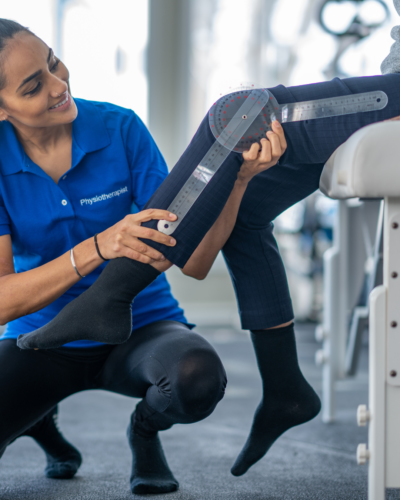
Allied health professionals play an important role in the health of people with neuromuscular conditions. Often a physiotherapist is a part of this team, with a focus on movement and muscular strength. To get to know more about how a physiotherapist can help and the role they play, we chatted with Lynne, Allied Health Clinical Lead at Muscular Dystrophy Queensland.
Allied health professionals play an important role in the health of people with neuromuscular conditions. Often a physiotherapist is a part of this team, with a focus on movement and muscular strength.
To get to know more about how a physiotherapist can help and the role they play, we chatted with Lynne, Allied Health Clinical Lead at Muscular Dystrophy Queensland.
For readers who may be new to this, can you explain what physiotherapy looks like for people with neuromuscular conditions?
Physiotherapy interventions include:
Physical assessments including gait and balance, posture, spinal alignment, range of movement, muscle strength and respiratory function
Advice and treatment regarding symptom management
Equipment trial and prescription for mobility aids including walkers, manual and power wheelchairs, scooters, and pressure relieving cushions
Specialised seating assessments
Hydrotherapy for individuals and groups
Training of family members and support workers in stretching programs, hydrotherapy and use of specialised equipment such as the cough assist device
We see people in their home, at a clinic, via telehealth, in schools and other community settings such as hydrotherapy pools. The frequency of visits depends on each individual circumstances and can range from weekly hands- on therapy to quarterly reviews (if the condition is fairly stable), and anything in between.
What are some common misconceptions people have about physiotherapy and muscle conditions?
One big misconception is ‘ if I do strengthening exercises with weights, I will get stronger’. This is not the case, especially in conditions where the muscle membrane is affected.
Truth: Low intensity exercises are more beneficial
There is another misconception about the effect of fatigue which means that someone can do something on one given day, but on another day or later in the same day they will struggle to complete the same activity. Misconception that they are being lazy.
Truth: Fatigue is ‘ unseen’ and fluctuates.
What physiotherapy approaches or techniques tend to be most beneficial for people with neuromuscular conditions?
There is no ‘ one size fits all’. However, bodies are meant to move, either on their own, or if that is not possible, then with help. Bodies that don’t move become stiff and stiff bodies, eventually becoming painful. Other techniques include low impact exercises, hydrotherapy and assistive technology to improve function and keep people safe.
How important is consistency versus intensity when it comes to seeing results? Is it possible for people with a neuromuscular condition to work too much?
Consistency is the key - high intensity workouts should generally be avoided. Pacing is also important. If they have a busy day then don’t exercise that day.
There are some conditions such as DMD where too much exercise or the wrong type of exercise (eccentric muscle contractions).
What role does hydrotherapy, stretching or assistive technology play in physiotherapy sessions?
These 3 elements are core components of physiotherapy for neuromuscular conditions
Hydrotherapy – safe fun environment for stretches, balance, breath control, relaxation. Provides an opportunity for movement that is not possible on land. Can be done in a group setting.
Stretches – very important. Joints and muscles are meant to move and range of movement is difficult to get back if it is lost.
Stretches need to be done in conjunction with positioning and supports. Teach support workers to do stretches so they can be done regularly.
How do physiotherapists work with other health professionals (like occupational therapists or neurologists) in managing a people with neuromuscular condition overall health and wellbeing?
We understand that we are part of a team supporting people with neuromuscular conditions. Communication is key so that services are not duplicated and everyone is on the same page. To ensure this it may be joint visits with OT, telehealth stakeholder meetings, regular communication via emails and getting hospitals to send reports following medical visits (with permission).
How do you involve the person’s support network (e.g. family, carers, or paid support) in physiotherapy routines?
We do this via:
Encourage attendance at sessions (as long as the client wants this)
Formal training of support workers and carers – stretches, cough assist machines, manual handling
Involvement in sessions – eg support worker may get in the pool as well with the client and physio
How can people stay motivated to keep up with their physiotherapy long-term? Everyone is guilty of feeling too tired to do it sometimes!
Educate the reasons why physiotherapy is important. People often move better and feel better after physio which will keep them going, but it can also be getting motivation from others in group sessions eg. hydrotherapy.
Learn more about how physiotherapy can benefit you or someone with a neuromuscular condition by visiting The Loop - Physiotherapy.